Worked
Nutshells - Day's Knob Site
| This is an interesting but
apparently unrecognized and problematic artifact form. Nutshells often appear
buried in context with
lithic artifacts, and these were initially dismissed as having been
deposited by animals, but sometimes this hard material has the definite
appearance of having been human-worked. The objects shown
below eroded from the bank above the spring that served as the site's water
supply, a particularly artifact-rich location. |
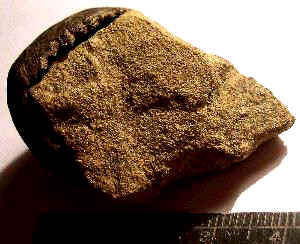
| Above, a sandstone, in the
common diamond-shaped (or kite-shaped) form and
incorporating the characteristic simple zoo-anthropomorphic imagery, is tightly
wedged into a nutshell (acorn?) apparently trimmed for the
purpose. |
|
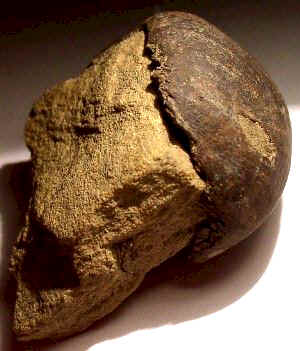
Another figure
like the one above, although less striking. |
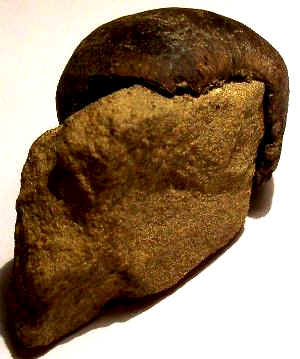
| This one incorporates a snail
shell rather than a stone. One might dismiss this as a
natural occurrence, but if the snail had just
happened to crawl into the hole and die, it seems improbable that after decomposition of
soft tissue the shell would have
remained so tightly wedged into the nut. (All a bit
speculative, of course...)
|
|
Top
of Page
| Click your browser's
"Back" button to return to the point from
which you entered this page. |
HOME

|
|